Ac Installation Fort Worth in Richland Hills, TX 76117: Expert Service
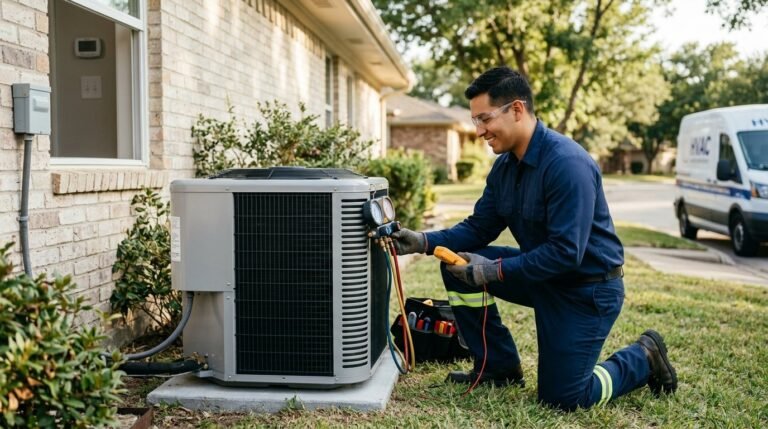
When an air conditioner can no longer cool reliably, runs up utility costs, or needs frequent repairs, a properly planned replacement can restore dependable comfort in a Richland Hills home. Professional AC installation should match the system’s capacity and efficiency to the home’s layout, insulation, windows, and cooling needs.
A qualified contractor can assess replacement signs, explain system options, outline installation-day steps, and review pricing and maintenance needs. Proper sizing matters because a Dallas–Fort Worth AC installation assessment considers more than square footage, including home features and occupancy.
Signs It Is Time To Replace Your Air Conditioner
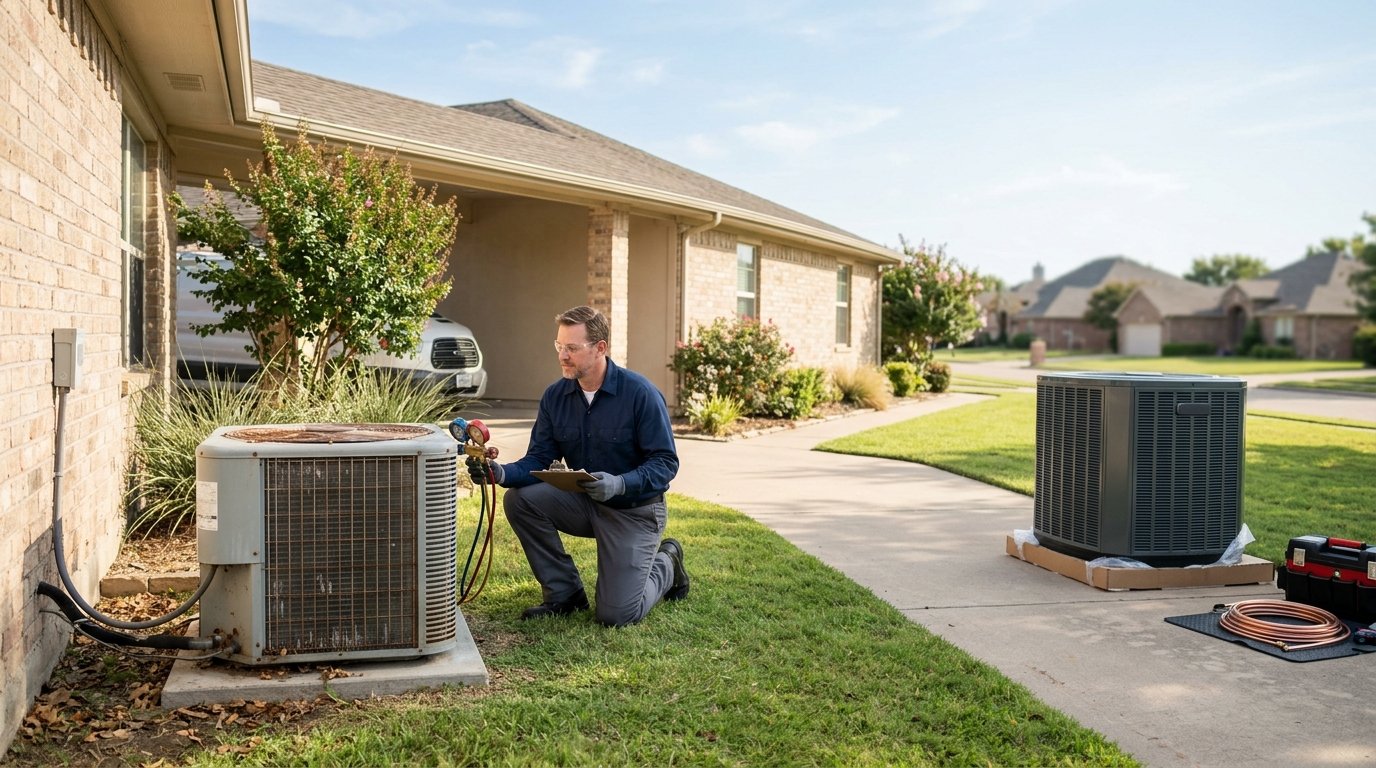
Repeated repairs, inconsistent temperatures, and increasing electricity use can indicate that an older system no longer performs reliably. A qualified evaluation helps a Richland Hills homeowner compare repair costs, system condition, and replacement options before a complete failure.
Frequent Breakdowns And Rising Repair Costs
An air conditioner that needs several repairs in one or two cooling seasons may have reached the point where replacement makes more financial sense. Common recurring problems include failed capacitors, refrigerant leaks, compressor trouble, electrical faults, and blower motor issues.
A single minor repair does not automatically justify a new system. However, a homeowner should consider replacement when the unit is near or beyond its expected service life, requires a major component repair, or continues to fail after recent service.
The commonly used $5,000 rule multiplies the repair estimate by the system’s age; a result above $5,000 can support comparing replacement costs rather than approving another major repair. It is only a planning tool, but it helps homeowners frame the decision alongside warranty coverage and technician findings. Fort Worth AC repair-versus-replacement guidance also identifies age and repair frequency as important decision factors.
Uneven Cooling Throughout The Home
Uneven cooling can show that an air conditioner no longer has the capacity or control needed for the home. A system may cool the thermostat area while leaving upstairs rooms, back bedrooms, or rooms with west-facing windows noticeably warmer.
Before replacing the equipment, an HVAC professional should check practical causes: a clogged filter, closed supply registers, damaged ductwork, poor attic insulation, thermostat placement, and airflow restrictions. Correcting those issues may restore comfort when the equipment remains in good condition.
If airflow and duct issues are addressed but the unit still runs continuously, short-cycles, or cannot maintain the selected temperature, replacement may be appropriate. Proper AC installation in Richland Hills should include a Manual J load calculation and equipment sizing rather than selecting a unit based only on the old system’s tonnage. Correct sizing supports more consistent room temperatures and humidity control.
High Energy Bills And Declining Efficiency
A noticeable increase in summer electricity bills, without a meaningful change in thermostat settings or household use, can signal declining AC efficiency. Aging compressors, worn fan motors, dirty coils, duct leaks, and refrigerant problems force the system to run longer to provide the same cooling.
Regular maintenance can correct some efficiency losses. A technician can clean coils, verify refrigerant performance, inspect electrical components, and measure airflow before recommending replacement.
Older equipment may still operate but use substantially more energy than a properly sized modern system. Systems around 10 to 15 years old deserve closer evaluation when energy costs rise or cooling performance declines, particularly during extended North Texas heat. Signs that an aging AC may need replacement include increasing utility costs and reduced reliability.
Choosing The Right System For Your Home

A properly sized, efficient system helps a Richland Hills home manage long cooling seasons without excessive cycling or uneven temperatures. Equipment selection should account for the home’s heat gain, duct condition, comfort goals, and available installation space.
Proper Cooling Capacity And Load Calculations
An installer should perform a Manual J load calculation before recommending capacity. This calculation evaluates conditioned square footage, ceiling heights, window size and orientation, insulation levels, air leakage, occupants, appliances, and local design temperatures.
A system that is too large can cool the air quickly but may shut off before it removes enough humidity. Frequent short cycles can also increase wear on components. An undersized unit may run for extended periods and still struggle during the hottest afternoons.
Homeowners should ask for the calculation results instead of relying on the size of the existing unit. Professional AC installation load calculations account for room layout and building features, not square footage alone.
Ductwork also affects delivered capacity. Leaks, restricted returns, or undersized supply ducts can prevent a correctly sized outdoor unit from cooling rooms evenly.
SEER2 Ratings And Energy Efficiency
SEER2 measures seasonal cooling efficiency under updated testing procedures. A higher SEER2 rating generally indicates lower electricity use for the same amount of cooling, but the best choice depends on purchase cost, expected operating hours, and installation quality.
For a home in Richland Hills, homeowners should compare more than the efficiency label:
- SEER2 rating: Indicates seasonal cooling efficiency.
- Variable-speed or two-stage equipment: Can provide longer, lower-output cooling cycles.
- Thermostat compatibility: Supports the equipment’s staging and scheduling features.
- Duct sealing and insulation: Limits conditioned-air loss before air reaches living spaces.
An efficient unit cannot compensate for poor airflow or leaky ducts. Qualified Fort Worth AC replacement and installation should include a review of the indoor equipment, refrigerant line set, electrical requirements, and duct system.
Central Air, Heat Pumps, And Ductless Options
Central air conditioning works well for homes with functional ductwork and a separate furnace or air handler. It provides whole-home cooling through supply registers and remains a practical replacement option when the existing duct layout fits the home.
A heat pump provides both cooling and heating by moving heat rather than creating it through combustion. It can replace a central AC unit and may reduce reliance on a gas furnace during mild Texas winter weather, though the home’s heating needs should guide the final configuration.
Ductless mini-splits use wall-mounted or ceiling-mounted indoor units connected to an outdoor condenser. They fit additions, converted garages, rooms with persistent comfort problems, or homes without ducts. They allow zone-by-zone temperature control, but indoor-unit placement and condensate drainage require careful planning.
What To Expect During The Installation Process
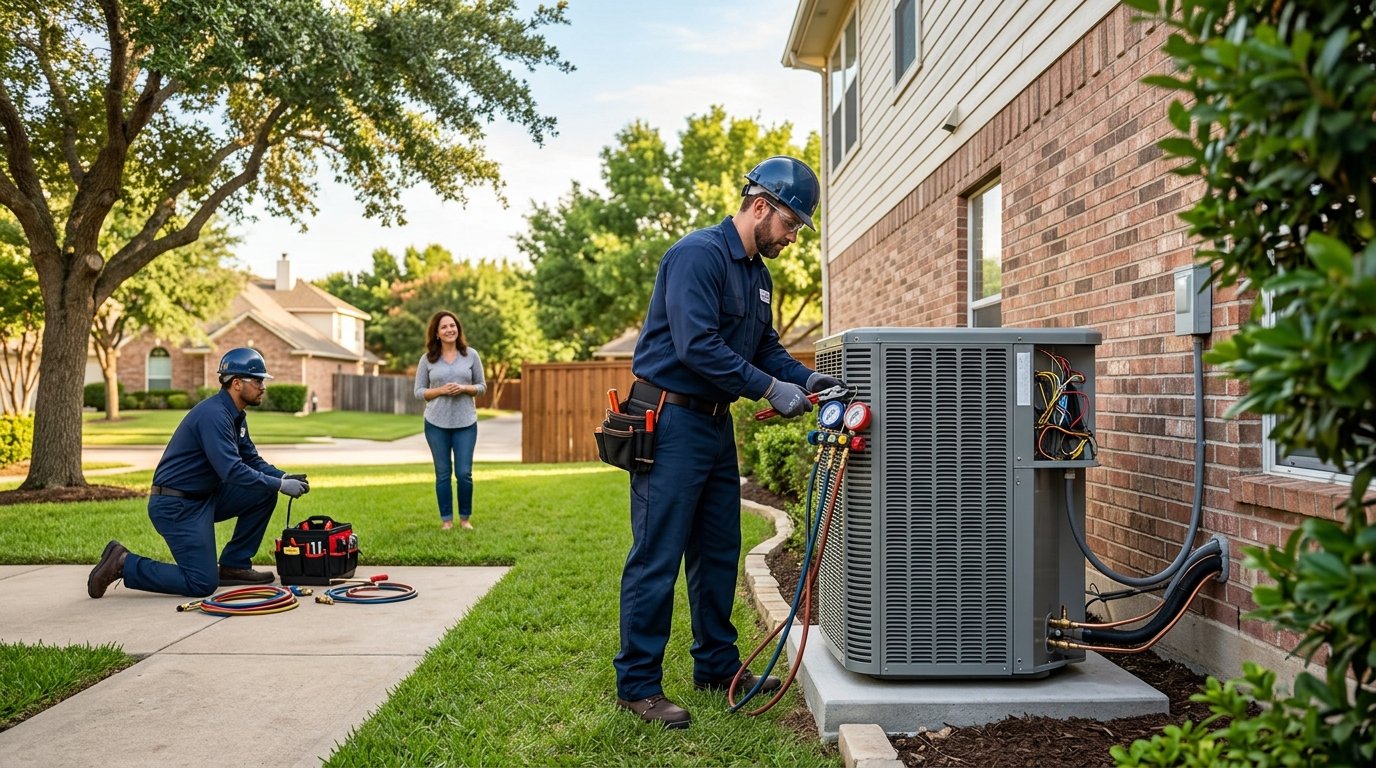
A professional installation includes a load assessment, removal of old components when needed, and verification that the new equipment operates safely. Most straightforward replacements take about four to eight hours, while electrical corrections, ductwork changes, or difficult access can extend the appointment.
In-Home Assessment And Written Recommendations
The contractor begins by examining the home’s existing indoor and outdoor equipment, duct connections, electrical disconnect, refrigerant line route, condensate drain, and thermostat wiring. They also check accessible ducts for loose joints, damaged insulation, or sizing problems that could limit airflow.
Equipment selection should not rely on square footage alone. A proper Manual J AC sizing assessment considers insulation, windows, room layout, occupancy, and other heat-gain factors relevant to a Richland Hills home.
The written recommendation should identify the proposed system’s capacity, efficiency rating, major included components, warranty terms, and the scope of work. It should also state whether the price includes permits, haul-away, electrical work, thermostat replacement, drain modifications, or duct repairs.
Removal Of Existing Equipment
Before removal begins, technicians shut off power to the existing air conditioner and recover refrigerant using approved equipment. They then disconnect the outdoor condenser, indoor evaporator coil or air handler connections, refrigerant lines, electrical wiring, and drain piping.
They protect nearby flooring and work areas while moving equipment through the house. If the installation replaces a split system, the team typically replaces the indoor coil with the outdoor unit; combining a new condenser with an incompatible older coil can reduce performance and create warranty issues.
Technicians inspect the equipment pad and mounting area before setting the new condenser. A level, stable base helps the unit drain correctly and limits vibration. They also clear debris and confirm that service access and airflow space meet manufacturer requirements.
System Setup, Testing, And Calibration
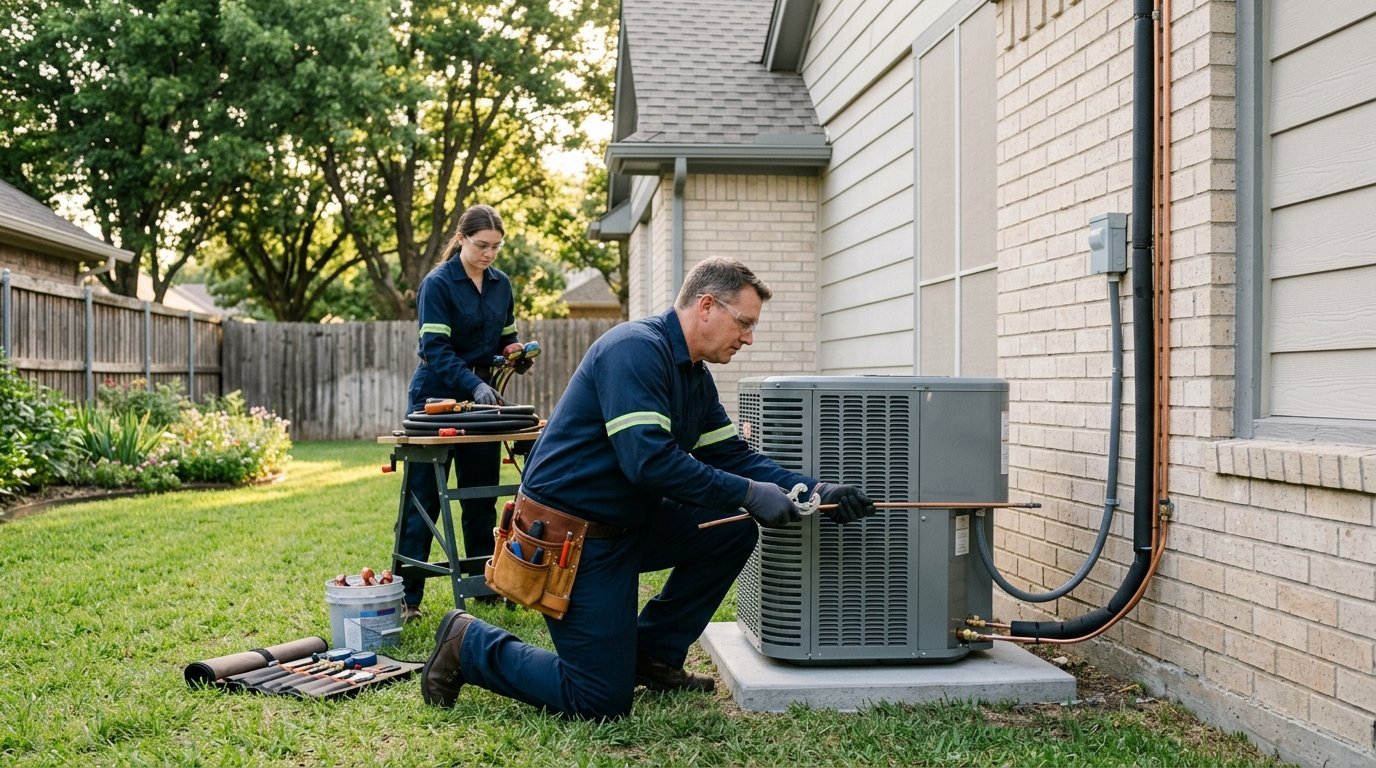
The installation team mounts and connects the new equipment, seals duct and cabinet connections, installs or reconnects the thermostat, and routes the condensate line to an approved drain location. They pressure-test refrigerant lines, evacuate moisture and air from the system, then charge it according to manufacturer specifications.
After startup, they measure supply and return temperatures, verify airflow, check electrical readings, inspect for refrigerant leaks, and confirm that the condensate drain flows freely. These steps help identify problems before technicians leave.
Installation duration varies with system type and site conditions; many standard replacements fall within the typical four-to-eight-hour AC installation window. The technician should show the homeowner how to operate the thermostat, replace filters, locate breakers, and register equipment warranties.
Local Considerations For Richland Hills Homes
Richland Hills installations should account for extended summer cooling demand, the condition of existing duct systems, and municipal approval before equipment is placed. Proper load calculations and code-compliant work help a system operate as designed.
Managing North Texas Summer Heat
North Texas summers put air conditioners under long daily runtimes, so equipment selection should begin with a room-by-room Manual J load calculation. The calculation considers conditioned floor area, window orientation, insulation, air leakage, occupants, and heat-producing appliances rather than relying on the size of the old unit.
An oversized system may cool rooms quickly but shut off before removing enough moisture. An undersized unit can run for extended periods without holding the thermostat setting during peak heat. Contractors should pair the selected unit with compatible indoor equipment and confirm airflow, refrigerant charge, and electrical capacity during commissioning.
Older properties may also have limited attic insulation or air leaks around penetrations, which increase cooling loads. A Richland Hills AC installation assessment should evaluate these conditions before finalizing equipment capacity.
Evaluating Ductwork And Indoor Air Quality
Many established Richland Hills homes have original or altered ductwork that may not match the airflow needs of a new high-efficiency system. Leaks, disconnected runs, crushed flex duct, inadequate return-air paths, and uninsulated attic ducts can reduce comfort and increase operating time.
The installer should inspect accessible ducts, measure static pressure, and verify supply and return airflow. Duct modifications may be necessary when a new air handler or furnace has different airflow requirements than the equipment it replaces.
Indoor air quality also depends on filtration and moisture management. A properly sized filter rack prevents air from bypassing the filter, while excessively restrictive filters can reduce airflow if the system cannot support them.
| Item to check | Why it matters |
|---|---|
| Return-air capacity | Prevents pressure imbalance and restricted airflow |
| Duct leakage | Limits loss of cooled air into attics or wall cavities |
| Condensate drainage | Reduces risk of overflow and moisture damage |
| Filtration fit | Helps capture particles without creating excessive resistance |
Meeting Local Codes And Permit Requirements
A replacement or new central air-conditioning system may require a permit and inspection through the City of Richland Hills. Requirements can vary by project scope, especially when work includes new circuits, disconnects, gas connections, structural changes, or extensive duct alterations.
The installing company should confirm applicable local requirements before work begins, obtain permits when required, and arrange inspections. They should also verify that the outdoor unit meets required clearances from property lines, windows, utilities, and service access areas.
Texas requires qualifying air-conditioning and refrigeration contractors to hold an active state license. Homeowners can ask for the contractor’s license information, permit responsibility, equipment model numbers, warranty documentation, and written scope before authorizing installation. Local conditions and service needs can also be reviewed through a Richland Hills HVAC contractor before scheduling the project.
Costs, Financing, And Available Savings
A replacement in Richland Hills, TX 76117 can vary substantially based on equipment capacity, efficiency, installation scope, and payment terms. Homeowners should compare written proposals that identify equipment, labor, required modifications, incentives, and financing costs.
Factors That Affect Project Pricing
A complete central AC replacement commonly costs more than an equipment-only changeout because the contractor must account for labor, refrigerant work, electrical connections, permits, and commissioning. One local provider lists Richland Hills AC replacement pricing from $8,000 to $20,000 or more, depending on system tier, tonnage, and duct condition.
The installed price can change when the home needs any of the following:
- A larger or smaller system based on a load calculation
- Duct repairs, resizing, sealing, or replacement
- A new electrical disconnect, breaker, or wiring upgrade
- A compatible indoor coil, furnace, or air handler
- Drain-line corrections, pad work, or attic-access labor
Higher-SEER2 equipment generally raises the upfront price, but it may reduce electricity use when it matches the home and is installed correctly. Contractors should provide the model numbers, warranty terms, efficiency rating, and all included work in writing.
Manufacturer Rebates And Energy Incentives
Manufacturer rebates may lower the purchase price on selected qualifying systems, often during seasonal promotions. Eligibility usually depends on the exact outdoor unit and matched indoor equipment, so homeowners should confirm that the quoted model combination qualifies before signing a contract.
Local utility programs may also offer limited incentives for qualifying high-efficiency HVAC equipment. A current Fort Worth HVAC replacement and Oncor rebate guide notes that efficiency upgrades can have utility-rebate opportunities, but program funding, equipment requirements, and application rules can change.
Homeowners should ask the installer for:
- The rebate amount and expiration date
- The equipment’s required SEER2 and other ratings
- Whether the contractor submits the paperwork
- Whether the quoted price already deducts the rebate
They should also verify any federal or state tax incentive directly with a qualified tax professional before treating it as a guaranteed discount.
Financing Options For New Equipment
Financing can spread the cost of a new system into fixed monthly payments, which may help homeowners replace failed equipment without delaying necessary work. Approval, interest rate, repayment term, and down-payment requirements depend on the lender and applicant credit profile.
Some Fort Worth-area companies advertise financing plans, including AC installation financing starting at $65 per month. That advertised payment may not represent the total cost for every project, so homeowners should review the full loan disclosure.
Before choosing financing, they should compare cash price, amount financed, APR, term length, monthly payment, and total of payments. A longer term can lower the monthly bill while increasing total interest paid.
If a promotion offers deferred interest or a temporary low rate, the homeowner should confirm when the promotional period ends and whether interest applies retroactively if they do not pay the balance in time.
Preparing Your Home For Installation Day
Clear access, electrical readiness, and a plan for people and pets help the installation crew work safely and avoid preventable delays. Homeowners can review a detailed AC installation checklist before technicians arrive and confirm site-specific requirements with the contractor.
Clearing Access To Equipment Areas
Residents should clear a direct path from the entry door to the indoor unit, attic access, electrical panel, and thermostat. Move furniture, rugs, storage bins, and fragile items from hallways and work areas before the crew arrives.
The outdoor unit location needs open working space. Trim back shrubs, remove patio items, and keep vehicles away from the driveway or gate the crew will use to bring in equipment.
If the air handler sits in an attic or closet, they should remove stored belongings around it and verify that the access opening is usable. The crew may need space for ladders, refrigerant equipment, tools, and the old unit.
Helpful preparation steps include:
- Unlock gates, utility rooms, and attic access points.
- Protect nearby flooring and remove valuables from the work route.
- Identify any tight stairways, low attic clearances, or parking restrictions in advance.
- Keep the installation area free of standing water, loose debris, and trip hazards.
Planning For Electrical And Thermostat Updates
A new AC system may require electrical changes, especially when the replacement unit has different power requirements. The homeowner should make sure the electrical panel is accessible and inform the contractor about known breaker issues, past tripping, or planned electrical work.
Technicians may need to shut off power during portions of the installation. Household members should charge phones, save computer work, and plan for temporary interruptions to cooling, lighting, or internet equipment connected to affected circuits.
The thermostat location also matters. Residents should tell the installer whether they want to keep the existing location or discuss a move before work begins. A thermostat should remain away from direct sun, supply vents, exterior doors, kitchens, and other heat sources that can affect temperature readings.
For smart thermostat installation, they should provide Wi-Fi details only when needed and confirm whether the existing thermostat wiring includes a compatible common wire.
Coordinating With Household Members And Pets
Installation work commonly involves equipment noise, open doors, and frequent movement through the home. Residents should tell household members when the crew will arrive and reserve another area of the home for remote work, naps, or activities requiring quiet.
They should keep children away from work zones, ladders, electrical panels, and outdoor equipment. One adult should remain available to answer access questions, approve thermostat placement, and review the final system operation.
Pets need a secure room, crate, or off-site arrangement during the appointment. Keeping pets separated prevents escapes through open doors and reduces stress from unfamiliar people and installation noise, a concern also noted in guidance on preparing a home for AC installation.
Protecting Your New Cooling System
Regular professional care, clean airflow paths, and complete paperwork help a new system operate as intended. Homeowners in Richland Hills should follow the manufacturer’s instructions and keep a documented maintenance history.
Seasonal Maintenance Recommendations
A licensed HVAC technician should inspect the system each spring, before North Texas cooling demand increases. A typical visit includes checking refrigerant performance, electrical connections, condensate drainage, thermostat operation, blower components, and outdoor-unit condition.
The outdoor condenser needs clear space for heat release. Homeowners should keep leaves, grass clippings, shrubs, and stored items at least 2 feet away from its sides, while avoiding damage to refrigerant lines or wiring.
They should schedule service promptly if the system cycles repeatedly, produces unusual sounds, leaks water indoors, or cools unevenly. Local providers offer Fort Worth AC repair, installation, and maintenance that can address developing issues before they place added strain on a new unit.
Filter Changes And Airflow Care
A restricted filter reduces airflow across the indoor coil and can make the system run longer than necessary. Homeowners should inspect the filter monthly and replace it based on its condition and the filter manufacturer’s guidance.
| Home condition | Typical filter-check interval |
|---|---|
| Standard household | Monthly |
| Pets, allergies, or frequent dust | Every 2–4 weeks |
| Higher-efficiency filter | Follow the labeled replacement schedule |
They should use the filter size and airflow rating specified for the equipment. Installing an overly restrictive filter can limit airflow, even when the filter is clean.
Supply registers and return grilles should remain open and unobstructed by furniture, rugs, or curtains. They should also avoid closing multiple vents to redirect cooling, since this can disrupt the airflow balance designed for the home.
Warranty Registration And Service Records
Homeowners should register the new air conditioner with the manufacturer soon after installation, following the registration deadline listed in the warranty documents. Registration may affect the length or availability of certain parts coverage.
They should retain the sales contract, model and serial numbers, installation invoice, warranty terms, and maintenance receipts in one accessible location. Digital copies stored in a secure cloud folder can prevent loss if paper records are misplaced.
Service records should identify the visit date, technician, work performed, replacement parts, and any system readings provided. This documentation helps technicians diagnose later concerns and may support warranty claims when the manufacturer requires proof of professional maintenance.
Selecting A Qualified HVAC Contractor
A qualified contractor verifies legal credentials, documents the full installation scope, and remains available when the system needs attention. These steps help homeowners compare AC installation providers in Richland Hills, TX 76117 on more than price alone.
Licensing, Insurance, And Technician Training
Texas requires an HVAC contractor performing air-conditioning work to hold the appropriate state license. Homeowners should ask for the company’s license number, verify that it is active through the Texas Department of Licensing and Regulation, and confirm that the license covers the proposed work.
The contractor should also carry general liability insurance and workers’ compensation coverage or an applicable alternative. Liability coverage can help address property damage caused during installation, while worker coverage reduces the homeowner’s exposure if a technician is injured on site.
Ask who will perform the work and whether the crew includes trained, supervised technicians. A contractor advertising a license number, such as this Richland Hills AC repair provider, gives homeowners a starting point, but they should still verify current credentials directly.
Written Estimates And Equipment Warranties
A written estimate should identify the equipment’s brand, model number, capacity, efficiency rating, and installed price. It should also state whether the price includes permits, electrical changes, thermostat replacement, refrigerant-line work, drain modifications, duct repairs, startup testing, and removal of the old unit.
Homeowners should not rely on a proposal that lists only “new AC system” and a total price. They need enough detail to compare equipment and labor scopes between bids, including any exclusions that could create added charges later.
The contractor should explain the manufacturer parts warranty, registration requirements, labor warranty, and who handles future warranty claims. An established Fort Worth-area HVAC installer serving Richland Hills may offer written warranty details, but the homeowner should receive the exact terms for the selected system before approving work.
Service Availability After Installation
Installation support matters after the crew leaves. The contractor should provide a final walkthrough, demonstrate thermostat operation, explain filter size and replacement intervals, and give the homeowner copies of permits, manuals, warranty documents, and the paid invoice.
Ask how the company handles a cooling problem discovered after installation. Important details include its normal service hours, emergency options, diagnostic fees, expected response process, and whether the same company performs warranty labor.
Homeowners can also review BBB-listed air-conditioning contractors near Richland Hills to identify local companies and research their business records. They should confirm that the chosen contractor has a clear service contact method and can support the specific equipment it installs.
Frequently Asked Questions
New equipment cost, correct sizing, repair decisions, brand selection, installation time, and financing depend on the home’s load calculation, ductwork, electrical capacity, and selected system features. A qualified contractor should inspect the property before providing a final recommendation.
How much does a new AC unit cost for a 2,000-square-foot home?
A new central AC system for a 2,000-square-foot home commonly costs several thousand dollars, with the final installed price often ranging from about $6,000 to $14,000 or more. This range can change substantially based on capacity, efficiency rating, duct repairs, thermostat upgrades, electrical work, and whether the outdoor condenser and indoor coil both need replacement.
A 2,000-square-foot home does not automatically require a particular system size or price. Local contractors can provide a property-specific estimate for AC installation and replacement in Fort Worth after reviewing the existing equipment and home layout.
What size air conditioner is needed for my home?
An HVAC contractor should size the system using a Manual J load calculation, not square footage alone. The calculation considers insulation, window area and direction, ceiling height, air leakage, occupant loads, duct condition, and North Texas summer temperatures.
Many 2,000-square-foot homes use systems in the 3- to 5-ton range, but the correct capacity can fall outside that range. An oversized unit may cycle too frequently and remove less humidity, while an undersized unit may run for long periods without maintaining the thermostat setting.
Is it worth repairing a 20-year-old AC unit or should it be replaced?
A 20-year-old air conditioner may warrant replacement when it has a major compressor failure, a refrigerant leak that is expensive to repair, repeated breakdowns, or declining cooling performance. Older systems can also use discontinued refrigerants, which may make certain repairs more costly or less practical.
Replacement is not automatic. If the repair is limited, the unit has a sound maintenance history, and it still cools effectively, a contractor can compare the repair cost against the price and expected efficiency of a new system. Homeowners in the area can request an assessment for AC replacement in Richland Hills before deciding.
Which AC brands are the most reliable for residential installation?
Reliable residential AC brands include Carrier, Trane, Lennox, Rheem, Ruud, Goodman, Amana, York, and American Standard. No brand performs well solely because of its name; correct sizing, careful installation, airflow setup, and routine maintenance strongly affect service life.
They should compare warranty terms, nearby parts availability, efficiency ratings, and the contractor’s experience with the chosen equipment. A properly installed mid-tier system can be a better choice than a premium unit installed without proper commissioning.
How long does a typical AC installation take?
A standard replacement of an existing split-system air conditioner often takes one full day, usually about 4 to 8 hours. More complex work may require one to two days.
Duct modifications, a new electrical disconnect, drain-line corrections, attic access limitations, or a complete system conversion can extend the schedule. Professional Richland Hills AC installation should include equipment startup, refrigerant charging verification, airflow checks, and thermostat testing before the technicians leave.
Are financing options available for a new air conditioner?
Many HVAC companies offer financing for qualified customers, often through third-party lending partners. Available terms, interest rates, promotional periods, and approval requirements differ by contractor and lender.
They should review the monthly payment, total financed amount, deferred-interest conditions, and any early payoff terms before signing. Some Fort Worth installers advertise AC installation consultations and financing-related options, but customers should confirm current terms directly with the provider.